
In this guide
Read the official profiles before the theories
Rockstar’s Jason Duval profile describes someone seeking an easier life after a troubled upbringing and military service. Lucia Caminos emerges from prison determined to improve her circumstances. Their official biographies offer a useful starting contrast: a shared future can appeal to two people for different reasons.
Checked November 3, 2026, this is a reading of published character material ahead of GTA VI’s release, not a review or a prediction of its ending. The RPG examples below use original characters. They explore a writing technique without claiming that Rockstar implements any particular companion mechanic.
Give partners a shared task and separate needs
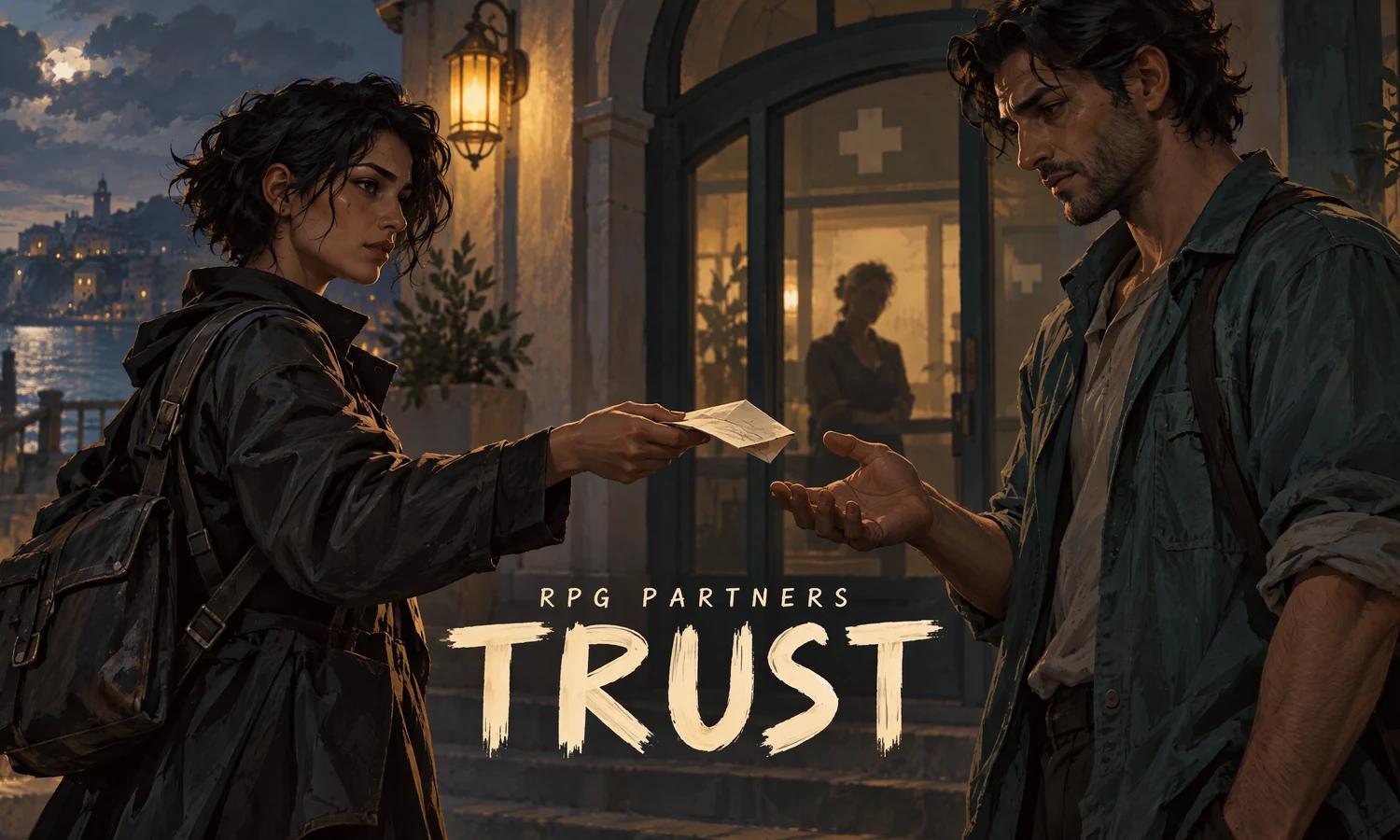
Create Mara, a night courier who wants to leave a coastal city, and Ivo, a neighborhood organizer who wants to stay. Both need to recover a missing parcel before dawn. The job gives them a reason to cooperate; their different futures give a conversation something to reveal.
Write one sentence for what each wants now, one for a boundary they will not cross, and one for what they mistakenly believe about the other. Mara thinks Ivo values the district more than any individual. Ivo assumes Mara has already arranged an escape. Neither belief has to be true.
Show trust through a costly decision
An abstract statement that the partners trust each other does little work. Instead, let Mara hand over the only message proving the parcel arrived. Ivo can disclose it publicly, protect the witness it names, or explain why he needs more time. The choice reveals priorities through an observable action.
Let the other character react to what happened rather than to secret information they could not know. If Mara hides a contact’s name, Ivo may notice her hesitation, but should not automatically learn the name. Unequal knowledge creates dialogue when the GM respects who heard, saw, or disclosed each fact.
Allow disagreement without taking over the player
A companion can refuse a plan, propose a different route, or demand an explanation. That makes them an active character. They should not silently decide that the player accepts a deal, spends money, or forgives a betrayal. End a disputed conversation at the point where the player has something meaningful to answer.
For example, Ivo refuses to leave a witness behind and offers to remain at the closed clinic. Mara’s player can stay, seek help, or leave with consequences. Avoid turning every disagreement into a mandatory betrayal. A partner with a consistent boundary can be dependable even when their preferred plan differs.
Try an original two-person dilemma
Use this opening: I play Mara, a courier recovering a missing parcel with Ivo, who knows the neighborhood. Give him his own priorities and knowledge. Begin outside a closed clinic as our witness asks for protection. Present what Mara can observe, let Ivo speak for himself, and wait for my decision.
Copy the premise into Playworlds Custom World and include the partners’ motives in your setup. This is one player exploring an NPC relationship through text, rather than a promise of two human players or GTA VI character simulation. Revisit one promise after the scene to see whether it still matters.